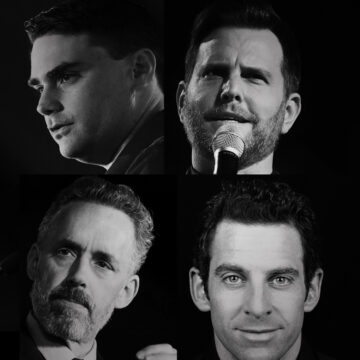
The group of thinkers now known as the “Intellectual Dark Web” — Jordan Peterson, Sam Harris, Bret and Eric Weinstein, Ben Shapiro — were convened in Dave Rubin’s garage and on his YouTube channel, The Rubin Report. And yet he has always suffered the accusation that he wasn’t a ‘real’ intellectual. In a world in which religious fundamentalism has been totally and completely debunked, authoritarian ideologies have no intrinsic moral or intellectual authority on which to base electoral appeals. This is why they seek to steal the identity of conservatism and market conservatism as moderation. “The real Trump derangement syndrome was not to have seen how appalling and dangerous and deranging it was to have a person like this get anywhere near the Oval Office,” Harris added.
- Now, its ideas and figures have helped elect a president, and some of them – Musk, Gabbard and Kennedy Jr – have roles in Trump’s administration.
- The intellectual dark web’s criticism of “woke” politics is centred on this disputed reality (and ideas about power) – spanning issues as diverse as biological sex and gender, debates over police violence and Black Lives Matter, and Diversity, Equity and Inclusion (DEI) policies.
- “The book was then investigated and it was determined that it could not return to sales in its current form.”
- But this typically did not include much consideration of the enabling terms of thought or discussion itself — least of all, of the media within which these take place.
The Intellectual Superstars Of The Trump Era Are Not As New As They Fancy Themselves
Peterson had been an obscure University of Toronto psychologist whose Jungian psychology–based first book, Maps of Meaning, reportedly sold about a hundred copies when it was first released in 1999; Weinstein and Heying had been faculty members at a tiny, very left-wing liberal arts college in Olympia, Washington. The intellectual dark web is perhaps a silly name for the group of thinkers it describes, but the search for a novel term does point to the radical transformation of American politics in our current moment. Donald Trump’s election has set off a chain reaction that has caused a great many Americans to rethink their ideological commitments and the place of those commitments within the broader society. For the people like Harris, Peterson, Rogan, Rubin, Sommers, Shapiro, Maher, and Weinstein, the noxious effects of political correctness on American society was the central lesson to be drawn from this recent history. And if the often glowing portraits of the dark web in publications like The New York Times and The Atlantic are any indication, or Peterson’s appearance at this year’s Aspen Ideas Festival, many liberals seem to agree. But though these figures believe their discovery has led them to form the basis of a new intellectual center in this changing context, recent history suggests their ideas may more likely find a home on the right.
The Rationale For The Federal Circuit’s ‘Radical Left’ Tariff Decision Is Fundamentally Conservative
THE FIRST DISTINCT intellectual movement to have emerged during the Trump presidency is not the alt-right, which rose to prominence during the 2016 campaign. Nor is it democratic socialism, the egalitarian platform that many young progressives have embraced since the Occupy Wall Street movement. As for whether YouTube’s recommendation algorithm played a role in introducing such content to viewers, the researchers did note that the algorithm did not recommend more extremist white supremacist content (i.e. those in the “alt-right” bucket).
The Intellectual Dark Web Podcast
It is what all institutions increasingly crave; a social and scientific consciousness, undivided by the mistakes of science, unphased by the measures of multiculturalism. The protests on campus were the result of an infantilizing and inconsiderate approach by Mr. Weinstein, to dismantle the objectives of student groups such as the First Peoples Multicultural Advising Services (now the First Peoples, Trans, and Queer Support Services) and their allies. This was done beneath the banner of free speech, a democratic concept that has long invoked peaceable assembly and the right to organize against injustice.
Who Thinks Biden Is A Bigger Threat To Democracy Than Trump?
Peterson exhorts men to follow a middle path between emasculation and being like the misogynist influencer Andrew Tate. These kinds of discussions had, for decades, been routinely shut down in universities. For example, last year, students called for the cancelling of “gender-critical feminist” Holly Lawford-Smith’s course on feminism at the University of Melbourne, due to her arguments for the significance of biological sex.

Image For IDW
But if you’re unwilling to make the hard decisions, you’re going to be left behind. As the group was confronted with a series of real-world political decisions—the rise of Trump, the COVID crisis, and the anti-CRT movement—it fractured, splintered, and decomposed. With some notable exceptions, such as Dave Rubin, Jordan Peterson, and Bret Weinstein, the “centrists” of the IDW could never move from the domain of criticism to the domain of action. They acted as if they could solve political problems through interminable podcast debates and failed to offer a viable theory of change. For postmodern thinkers, the task of the intellectual activist is to prevent or transform the speech of the powerful.
Recently, I was pleasantly surprised to discover Eric Weinstein’s YouTube channel, which stands in sharp contrast to the many time-wasting videos that dominate the platform. Eric Weinstein is a mathematician, economist, and managing director of Thiel Capital (not sure if he is still there). He is known for coining the term “Intellectual Dark Web” and is currently involved in intellectual discussions, podcasts, and exploring topics related to physics, economics, and societal issues. To highlight Eric’s background, it’s worth noting that he completed his PhD under the supervision of Raoul Bott, a distinguished mathematician. Bott made substantial contributions to topology, differential geometry, and mathematical physics. And it is less well appreciated is that the online alt-right orchestrated by Cernovich, Yiannopoulos, and others had origins quite similar to the somewhat more respectable dark web types that Weiss’s piece describes.

Similar Content Being Viewed By Others

The extensive research employed in developing LIWC motivated us to use it in our methodology. In our work, we employed LIWC to analyze each word of an input text automatically, attributing it to a psycholinguistic class. Then, it calculates the overall frequency of each one of its categories in the input text. We relied on the frequency report returned by LIWC for the analyses of our second research question, implementing minor pre-processing, namely the removal of URLs and covert all text inputs to lowercase. But Whig history’s “moral progress” can also be seen as a paradigm dependent on print.
Early commentators on the digital revolution tended to assume that this would simply accelerate the existing trajectory of the print revolution, and thus continue Whig history. Yet Kisin is right to express a newfound ambivalence about that core print-era value, free debate, for the simple reason that existing evidence suggests the digital revolution is not extending but reversing many aspects of the print paradigm. Taken together, these changes have tended to be narrated in hindsight as self-evidently positive, irreversible progress — what the historian Herbert Butterfield called “Whig history”. This settlement is also, broadly speaking, what IDW advocates gesture at when they use terms such as “classical liberalism” and “Western civilisation”.
The Intellectual Dark Web
Their ranks are generally said to include Jonathan Haidt, Dave Rubin, Jordan Peterson, Sam Harris, Ayaan Hirsi Ali, Claire Lehmann, and James Damore. There is a particular trait evoked in a kind of playful teasing that actively counters intuition. It is the recognized life of inner mastery, which allows for a certain agency of repose. There is, decidedly, a lack of this exhibited by those who fall under the moniker of the IDW. Their lucrative, “free reach” populism, set on debasing the truest forms of free speech, and on dictating the parameters of cultural relativism, can only be countered through utmost vigilance, in media and beyond.
He also realized that because the political press mostly spent its time spectating at news conferences and collecting gossip, he could very easily present a sanitized message to the public while privately being far more radical. Even as Buckley advocated for authoritarian policies such as racial segregation, invasions of foreign countries that were insufficiently capitalist, and criminalizing abortion and birth control, he portrayed himself as a sybaritic harpsichord player who spoke with Transatlantic accent. The National Review founder also used his PBS television show Firing Line to present himself as a reasonable conservative. Incensed at Eisenhower and the conservatives, the self-described “individualists” worked tirelessly to impose their ideology on the Republican Party and the nation as a whole. They hailed the authoritarian efforts of Wisconsin Sen. Joseph McCarthy to intimidate and slander government officials, and wanted them expanded into other areas, including the suppression of non-believing and socialist college professors, as Buckley demanded in his first book, God and Man at Yale.
Others have argued it is a cover for dated ideas, such asrace-IQ theorizing, that society has already tested and rejected. If the IDW’s ranks expand far enough to encompass conspiracy theorists Mike Cernovich and Alex Jones, then things quickly escalate from dated to dangerous. Meanwhile, others lauded the piece, including cognitive scientist Steven Pinker who described it as an “excellent analysis” (shown below, left) and journalist John Podhoretz who referred to it as “intellectual journalism at its best” (shown below, right).
Join Like Minded Readers That Support Our Journalism, Read Unlimited Articles And Enjoy Other Subscriber-only Benefits
Fixing our institutions is necessary before society can make real progress, Weinstein suggests, and a solution doesn’t lie solely with the left or right. This problem stems in part from two generations’ worth of dishonesty — both subtle and obvious — from society’s accepted experts, many of whom have been corrupted by their institutions’ relentless drive to survive and continue growing, no matter the cost. It’s from this problem, Weinstein suggests, that the Intellectual Dark Web emerged.
ProZD Race-Based Casting Controversy
Per the subtitle of his book, Roberts suggests that the IDW has served its purpose. Some of the people mentioned in it, such as Sam Harris, have already distanced themselves from IDW to maintain their intellectual independence. Also per the subtitle, Roberts suggests that the intellectual impact of IDW will last much longer. Every radical feminist I knew in 2015 got cancelled by the left for thoughtcrimes against transgender ideology and the glorification of ‘sex work’. Put simply, “in the Postmodern tradition, problems come from discourse and are thus solved by changing discourse”—that is, ‘no debate’. Any attempt to widen the acceptable range of opinions on campus is deemed ‘harmful’ and subject to protest.
- In the 1990s, left and progressive thinkers including Richard Rorty, Cornel West, and Edward Said made clear their reservations about certain activist tactics, and articulated positions in line with the same universalist values neoconservatives claimed as their own.
- We use the CLS token output to capture contextual embedding representations for all entries of the balanced dataset sample.
- The term “intellectual dark web” was coined, almost tongue-in-cheek, in early 2018 by Eric Weinstein, a mathematician, manager at Thiel Capital, and op-ed writer, and was meant to recognize a network of “renegades” in academia and media who reject identity politics in the name of unhindered dialectic (“free speech”).
- Bret Weinstein, meanwhile, has followed the well-trod “Pastel QAnon” path, going from Bernie-Sanders-supporting college professor to deranged conspiracy theorist podcaster who constantly claims his ideas should be debated while also refusing to ever actually book his critics on his show.
Google has a huge effect on what we think, because it has a huge effect on what we see when we search for things. It understands or at least is capable of evaluating our email for patterns and figuring out what it is that we’re beginning to suspect. Google is a very dangerous entity if it decides to take an active role in controlling what conversations can happen, and Google has told us that at the very top, it is actually interested in seeing some conversations silenced. That should worry us at least as much as what’s going on on college campuses, which is itself not a small matter. Whatever the adjectives, it’s a group of people, many of them familiar to Reason readers, who are interested in free speech and free thought, sensitive to intellectual conformity, and adept at using new media to route around hostile gatekeepers.